My background
Until recently, getting certified wasn't on my radar. I earned the AWS SAA (Solutions Architect – Associate, the intermediate level) more than 10 years ago. I've been involved in designing and operating AWS environments as part of my day job, so I'm confident in my AWS skills. My attitude was basically, "Certification exams? What a hassle."
What changed my mind was browsing public tenders. In the eligibility requirements, AWS certifications were listed as a matter of course. No matter how much hands-on experience you have, without them you can't even get in the ring.
The other reason is AI. Thanks to generative AI, anyone can now build a reasonably decent web app. Claims like "I have experience" that used to carry weight will carry less and less from here on. I felt I needed to make my experience visible.
I'm 49. The thought of sitting down at a desk to study again for the first time in ages actually got me a little excited.
Timeline
Striking while the iron was hot, I booked the exam right away so I'd have no choice but to study. A short, all-out sprint!
| 6/17 | Signed up for a CloudTech certification membership |
| 6/18 | Booked the AWS SAA certification exam |
| 6/20 | Took the SAA (Associate) on a roll → recertified |
| 6/21 | Booked the AWS SAP certification exam |
| 7/2 | Took the SAP (advanced level) → passed (score: 802) |
I first took the SAA (intermediate level) to win back the certification I once had, then rode that momentum into the SAP (advanced level). Some students preparing for entrance exams use a similar strategy to build a habit of passing. On top of that, taking the SAP directly costs ¥44,000, but AWS offers a perk where passing an exam gets you 50% off your next one. So SAA (¥22,000) → SAP at 50% off (¥22,000) still totals ¥44,000. The cost is the same either way.
For study materials, I used almost nothing but CloudTech's practice questions. I knew I'd never get through a thick study guide anyway, so I didn't buy one. Instead, I relied on the Claude extension.
I first felt the power of studying with AI while preparing for the SAA
After reading a few blog posts, I subscribed to CloudTech, which they recommended. CloudTech's explanatory videos and question sets are very well made, and my confidence grew quickly. My plan only let me watch a few of the videos, but since I was already feeling confident, I went ahead and booked the SAA (intermediate level) exam. Then I worked through the question sets to pin down my weak spots. EKS, SCPs, the finer behaviors of S3, anything Windows-related, CloudFormation, CodeDeploy, DynamoDB ── even after 10 years, the areas I don't touch day to day turned out to be surprisingly full of holes, and for a while I was honestly stunned.
As I worked through the questions, I realized the Claude extension I had recently installed was really handy. There's no need to switch tabs and copy-paste; you can just ask casually from the side of the screen, so the friction is almost zero. CloudTech's explanations are clear, but I just couldn't bring myself to read them. That's because they don't pinpoint exactly what I want to know, and studying by input alone gets boring fast.
The Claude extension, on the other hand, is effortless to use and answers exactly what I want to ask, so my motivation never dropped.
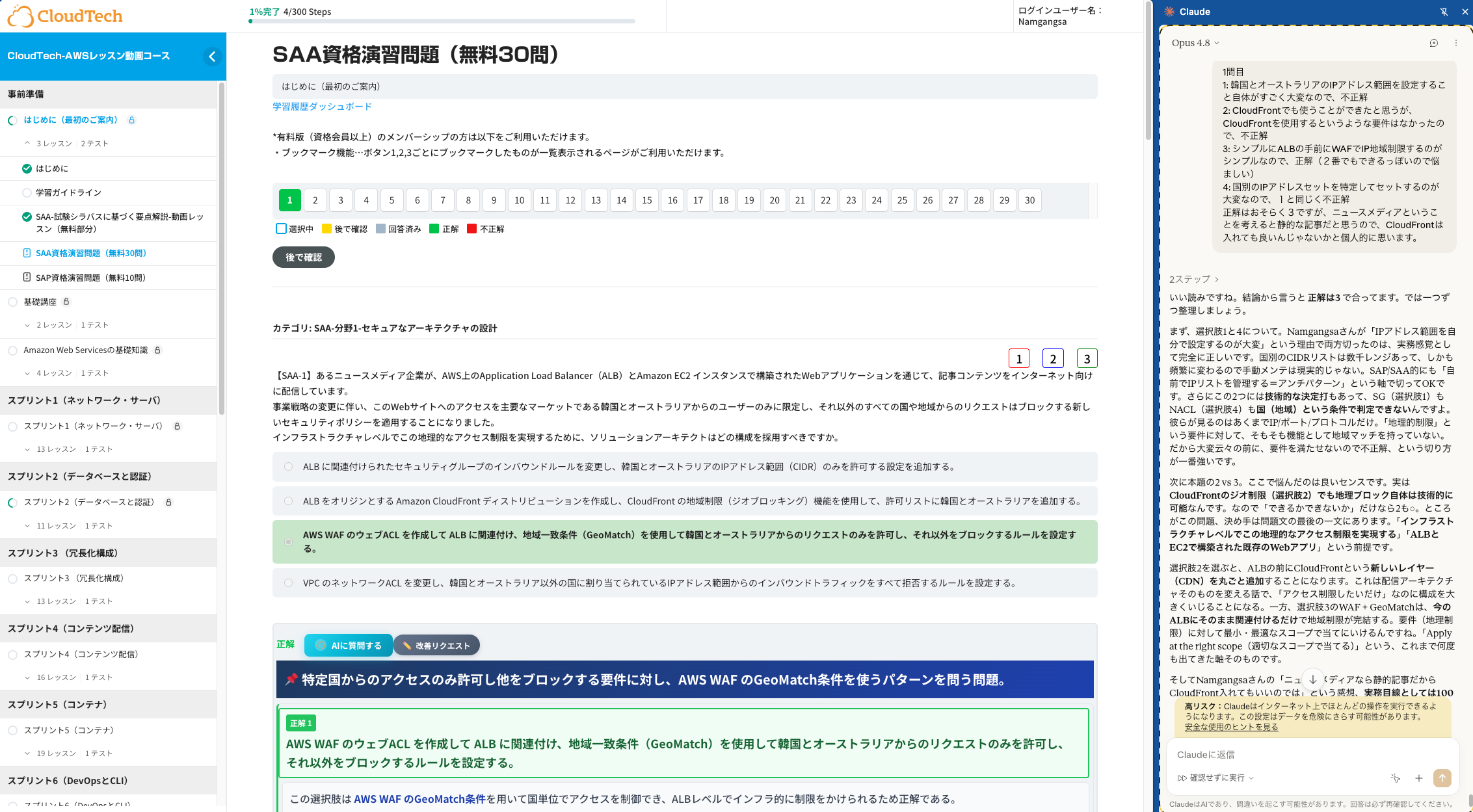
The AI study workflow that worked for me
First, what's great about the extension:
- It understands the context without any copy-pasting, so there's no wasted switching and everything feels seamless. It's simply easier.
- Switching to "act without asking" mode cuts down on approval clicks, which is a relief! (It does carry risks, though, so use it at your own discretion.)
And here is the workflow I used to study.
- First, come up with your own answer. Break down the question's requirements in your own way. Even if an option includes a service you don't know, you can usually eliminate a few choices. Write out your process-of-elimination logic, like "this one should be wrong for this reason", then settle on what you think is correct. I believe building up your elimination logic carefully is what raises your accuracy on the real exam.
- Have the AI judge your answer and evaluate your reasoning. Ask it not only whether you got it right, but whether your reasons for eliminating options were sound. The AI usually praises you, which is simply nice to hear. Quietly, that becomes what keeps you going.
- Fix your mistakes, and try mapping what you don't know onto "things you do know". For example: "So a Connect phone number is reserved much like an Elastic IP?" The thing you map onto doesn't have to be within AWS. One analogy I picked up from CloudTech's explanations, "an SCP is like a constitution", is the one that clicked the most. No matter what rules exist below it, they can't go beyond that framework. Technical or not, anything works as long as it makes sense to you.
- Throw in some small talk. I'd chat with it about things like "Hardly anyone has actually worked on a service this big, right?" or "My accuracy has been going up lately, I'm on a roll ── maybe I'm a genius," and let my imagination run.
- Once it makes sense and really clicks, it stops being a chore. Even services you didn't know get tied to something in your existing knowledge. At that point, you remember them naturally without even trying.
In the end, what you're after isn't the mapping itself but "understanding", so if something makes sense right away, there's no need to force an analogy.
The AI, for its part, will often tailor its explanations to familiar examples it thinks I'll understand. This exchange isn't one-way Q&A: the AI meets me on my own turf, and I restate it in my own words, "So, in other words, it's like this, right?" ── I think it's in that back-and-forth that understanding takes shape.
How do you prove your experience in the AI era?
Precisely because AI now lets anyone build things, I feel the combination of "real-world experience" and "a certification that proves it" has taken on new meaning. And even the studying for that certification, I did together with AI.
At MOOBON, we use Claude in our everyday AWS builds and operations as well. Our write-up on running WordPress with Claude Code is one example. All I did was bring that same mindset to my own relearning.
If you're struggling with anything in your AWS architecture or operations, feel free to get in touch.
Update: my July 2 result
The result: Pass, with a score of 802 (passing score: 750). Exactly half a month from June 17, when I started studying in earnest. For now, I managed to go the distance just as I'd planned.
Here are my honest impressions from sitting the exam. On the real thing, the questions are just really long. It's a three-hour exam, and there were moments when my concentration slipped and the text simply wouldn't sink in. In those moments, instead of rushing, I stayed calm and restated the question in my own words and pictured the scenario, and it clicked right away. That was exactly the "understand by restating" habit I had been practicing with the Claude extension while studying.
One more reading tip: if you check the part at the end of the question that states what the requirement is, along with the answer choices, before reading the body, you won't have to reread long passages over and over, which saves time.
A score of 802 is far from perfect, which also means I still have gaps. Even so, I went in with a short sprint and passed ── so the result lets me say this study method worked, at least for me.
I'm simply happy to have earned the certification. Beyond that, this way of learning through dialogue with AI carries straight over into day-to-day AWS architecture and operations. If you're struggling with anything AWS-related, feel free to get in touch.
Frequently Asked Questions
QWhat study materials did you use?
Almost nothing but CloudTech's practice question sets. I barely opened any thick study guides. CloudTech also has explanatory videos, but my plan only gave me access to a few of them, so I switched to working through past exam questions and knocking out unfamiliar services one by one. Whenever I didn't understand something, I asked the Claude extension. For me, this combination of "practice questions + dialogue" was by far the most efficient.
QHow exactly do you use the Claude extension?
Rather than asking for the answer right away, I come up with my own answer first. I break down the question's requirements, and even if an option includes a service I don't know, I write out my process-of-elimination logic, like "this one should be wrong for this reason", before settling on what I think is correct. Then I have the AI judge my answer and evaluate my reasoning, fix what I got wrong, and map the unfamiliar services onto things I already know. The key is to use it not as one-way Q&A, but as a sounding board you go back and forth with.
QDoes this study method work if you don't have hands-on experience?
To be honest, I think this method worked because I had a foundation of more than 10 years of real-world experience. I already had a decent amount of "known knowledge" to map newly learned services onto. I can't say whether someone with no experience at all would progress at the same pace doing the same thing. My sense is that the more experience you have, the better this method works.
QHow long did it take you to get the SAA (Associate)?
The SAA I earned more than 10 years ago had long since expired, so I started by retaking it. I sat the exam a few days after signing up for CloudTech, cramming mostly with past questions. It was during that SAA prep that I realized "working through questions while asking the Claude extension is fast", and that was the origin of this study method. I rode that momentum straight into the SAP.